
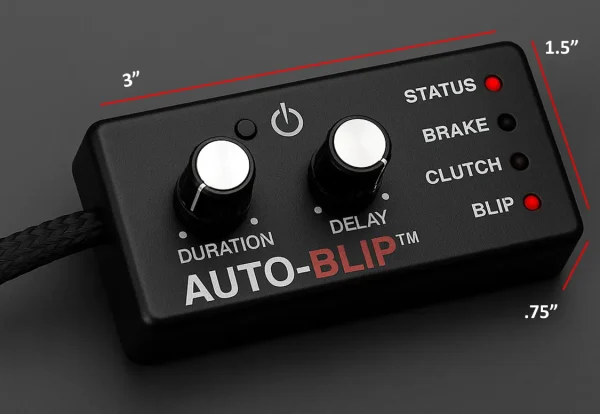
Why Every Track Rat Is Quietly Installing AUTO-BLiP
We've all seen the footage. Some pro driver in a GT3 dancing on the pedals like a ballerina, nailing every single heel-toe downshift before a hair-pin. It looks cool. Super smooth. But back in the real world? Trying to do that yourself during a heated session is a nightmare. You're standing on the brakes, twisting your ankle like a pretzel, and trying to blip the gas with the side of your shoe—all while trying not to fly off the track.
Most of us just end up mashing the pedals and praying. It takes years to get "okay" at it. Some guys never do.
That’s where the AUTO-BLiP comes in. Because honestly, pedal gymnastics shouldn't be the reason you're slow.
What is this thing, exactly?
Think of it as a tiny digital co-driver. It's a small module—about deck-of-cards size—that handles the throttle blip for you. It wires straight into your pedal sensors (gas, brake, and clutch). When it sees you hit the brakes and then dip the clutch, it knows exactly what’s up. It sends a split-second signal to the throttle to rev-match the engine perfectly for the lower gear.
You're still the one driving. You still choose the gear, you still work the stick, and you definitely still steer. It just deletes the part of the job that requires you to be a circus performer.
Why does it actually matter? (Hint: It’s not just the sound)
A perfect rev-match sounds mean. But it’s actually about keeping the car from freaking out. If you drop a gear without matching the RPMs, the whole drivetrain hitches. The wheels want to go fast, the engine is dragging, and the clutch is stuck in the middle trying to fix your mistake.
That "jolt" you feel? That’s weight transfer. And it usually happens right when you’re turn-in or heavy on the brakes. At best, it ruins your line. At worst, it locks the rear tires and sends you spinning into the weeds.
With a perfect match, the car stays dead-flat. No drama. Just a seamless transition so you can actually focus on your apex instead of wondering if your right foot is in the right spot.
The Specs & The Install
This isn't some new, unproven toy. AUTO-BLiP has been a track staple for 14 years. Over 5,000 units are out there. If your car was built in the last 20 years and has an electronic throttle, it’ll probably work.
- Standard Unit: For the vast majority of modern manuals.
- C5 Corvette Version: Tuned specifically for that car’s unique sensor setup.
- The "Plus" Unit: For the newer stuff like the GR86/BRZ that uses active sensors.
If you can handle basic wiring, you can install this. It doesn't mess with your ECU, it won't throw codes, and it doesn't mess with diagnostics. Once it’s in, you run a 60-second calibration. After that, there are two dials on the box. You can literally reach down and adjust the "strength" and "timing" of the blip between sessions.
"Isn't this cheating?"
Purists love to complain. But look at the new Nissan Z, the Corvette Z06, or any modern Porsche. They all have auto rev-matching from the factory. All AUTO-BLiP does is give that same tech to cars that were built before it was standard.
You’re still shifting a manual. You’re still doing the work. You’re just removing a massive point of failure. And when you stop stressing about your feet, you usually start driving a whole lot faster.
Give it one weekend. Once you feel how much more stable the car is on entry, you won't care about the "cheating" comments. You'll be too busy looking at your improved lap times.